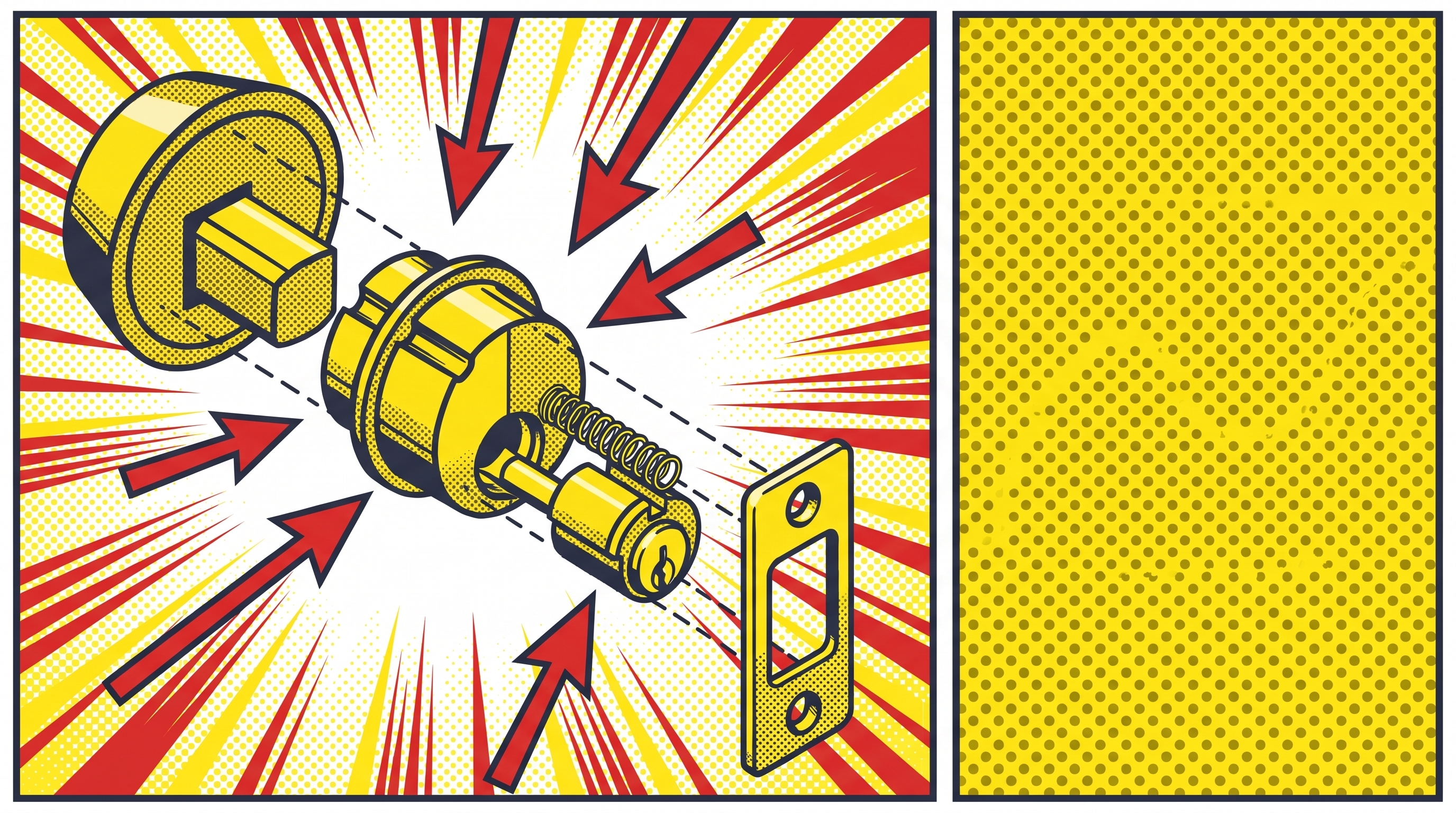
If you’ve ever asked a locksmith what the single best upgrade you can make to your home’s security is, the answer is almost always the same: install a quality deadbolt. But what exactly is a deadbolt, how does it work, and how does it compare to the standard spring latch on most doors? This guide covers the mechanism, the tradeoffs, and what to look for when it’s time to install or upgrade one.
What Is a Deadbolt Lock?
A deadbolt is a locking mechanism where a solid metal bolt, typically hardened steel, extends directly into the door frame when locked. Unlike a spring latch, the deadbolt has no spring mechanism. It only moves when you physically turn a key or thumb turn. That single design difference is what makes deadbolts significantly more resistant to forced entry.
The bolt itself is usually one inch long when fully extended, and it seats into a strike plate mounted in the door frame. On a properly installed deadbolt, that bolt goes through the strike plate and anchors into the wall stud behind it, making it extremely difficult to kick or pry open.
Single Cylinder vs Double Cylinder Deadbolts
This is one of the most common questions homeowners ask when shopping for a deadbolt. Here’s how they differ:
Single Cylinder Deadbolt
A single cylinder deadbolt has a keyed cylinder on the exterior side and a thumb turn on the interior side. This is the standard configuration used in most homes. You lock and unlock from the outside with a key; from the inside, you simply turn the thumb turn with your hand. No key required to exit.
Single cylinder deadbolts are appropriate for most Austin homes. They’re convenient, meet most building codes, and provide strong security.
Double Cylinder Deadbolt
A double cylinder deadbolt requires a key on both sides. There is no thumb turn. You need a key to unlock from inside and outside.
Double cylinder deadbolts are sometimes recommended for doors that have glass panels near the lock, because a standard single cylinder deadbolt could be reached and turned from inside if someone broke the glass. With a double cylinder, that attack path is blocked.
The trade-off is real. In a fire or emergency requiring fast exit, a double cylinder deadbolt creates a serious risk if the key isn’t immediately accessible. Texas fire codes have specific requirements in certain occupancy types. For residential use, if you install a double cylinder deadbolt, keep a key on a nearby hook that can be grabbed quickly in an emergency, just not within arm’s reach of the glass panel you’re trying to protect.
How a Deadbolt Works: The Mechanism
When you turn a key in a deadbolt cylinder, you’re rotating a cam inside the lock. That cam is connected to a tailpiece that drives the bolt horizontally. As the cam rotates, it pushes the bolt outward (locking) or retracts it (unlocking).
The bolt is made of hardened steel and extends fully one inch into the strike plate when locked. Quality deadbolts (Grade 1 ANSI-rated locks) use anti-pick pins inside the cylinder, hardened steel inserts in the bolt to resist sawing, and a rotating anti-drill plate around the cylinder face.
This is how a deadbolt mechanism differs from a door knob’s spring latch:
| Feature | Deadbolt | Spring Latch |
|---|---|---|
| Bolt type | Solid, driven by key/thumb turn | Spring-loaded, angled |
| Retracted by | Key or thumb turn only | Turning the knob or pressing |
| Susceptible to credit card attack | No | Yes |
| Susceptible to shimming | No | Yes |
| ANSI Grade 1 available | Yes | Rarely |
| Typical security rating | High | Low-Medium |
Why a Deadbolt Is More Secure Than a Spring Latch
A spring latch, the one you’ll find on most door knobs, is beveled on one face. That bevel lets the door close without a key: the latch compresses as the door closes, then springs back out once it clears the strike plate. This convenience comes at a security cost.
Because the latch is spring-loaded and angled, it can be manipulated from outside with a thin card, a shim, or a loidal tool slipped between the door and the frame. This is called “credit card attacking” and it takes under 30 seconds for someone who knows what they’re doing.
A deadbolt has no spring. The bolt does not move without deliberate actuation: a key in the cylinder or a hand on the thumb turn. There is no bevel to exploit, no spring to compress. Combined with proper installation (a reinforced strike plate with 3-inch screws into the stud), a quality deadbolt is the most effective single upgrade you can make to a residential door.
When Should You Install or Upgrade a Deadbolt?
Consider installing or upgrading a deadbolt in these situations:
Moving into a new home or apartment. Previous tenants or owners may have copies of existing keys. Rekeying the deadbolt or installing a new one is the fastest way to establish control of who has access.
After a break-in attempt or burglary. If an intruder has targeted your home, your existing hardware has been assessed. Upgrade immediately.
Your current deadbolt is more than 10 years old. Older locks may have worn cylinders that can be picked or have weakened bolts from repeated use.
Your strike plate is installed with short screws. This is one of the most common security failures we see in Austin homes. A strike plate held by half-inch screws can be kicked out in one blow. Three-inch screws into the stud frame are the standard we install.
You’re renting and want additional security. Texas law requires landlords to provide a working deadbolt on exterior residential doors. If yours is missing or broken, you have a legal right to request one.
What Does Deadbolt Installation Cost in Austin?
For a standard single cylinder deadbolt installation in Austin, expect to pay in the range of $75-$175 installed, depending on the lock grade and whether any door frame repair is needed. That price typically includes:
- The deadbolt hardware (Grade 2 or Grade 1)
- Drilling or retrofitting the door if needed
- Reinforced strike plate with 3-inch screws
- Key duplication if requested
If you’re upgrading an existing deadbolt with a new one of the same size, installation is faster and costs less. If you’re converting a door that previously only had a spring latch and a new bore hole is required, add time and cost for the additional work.
WOW Locks provides flat-rate deadbolt installation quotes before any work begins. The price quoted is the price you pay. No surprise labor charges after the job is done.
What to Look for in a Quality Deadbolt
Not all deadbolts are equal. When selecting one, look for:
ANSI Grade 1 rating. The American National Standards Institute grades residential locks from Grade 1 (highest) to Grade 3 (lowest). Grade 1 locks withstand significantly more kick and pick testing than Grade 3. Schlage B60N and Kwikset 980 are commonly used Grade 1 examples.
Anti-pick pins. Security pin sets inside the cylinder that make picking substantially harder.
Anti-drill protection. A hardened steel plate or insert that prevents a drill from destroying the cylinder.
One-inch throw. The bolt should extend a full inch when locked. Shorter throws seat shallowly in the strike plate and offer less resistance to force.
Reinforced strike plate. The strike plate is as important as the lock itself. A quality installation includes a heavy-gauge strike plate with at least 3-inch screws.
Frequently Asked Questions
Can a deadbolt be picked?
Any lock can theoretically be picked given enough time and skill. Quality Grade 1 deadbolts with security pin sets are designed to resist picking by all but the most experienced locksmiths. In practice, most residential break-ins don’t involve lock picking at all. They involve kicking, prying, or breaking glass. A deadbolt properly installed with a reinforced strike plate addresses the kick-in attack effectively.
Is it possible to kick in a door with a deadbolt?
If the strike plate is installed with short screws, yes. A single well-placed kick can split the door frame and pull the strike plate free even with a quality deadbolt installed. The fix is a heavy-duty strike plate installed with 3-inch screws that reach the wall stud. When WOW Locks installs a deadbolt, reinforced strike plate installation is standard. Not optional.
Can I install a deadbolt myself?
Deadbolt installation is within reach of a handy homeowner for a standard retrofit where the door already has the correct bore holes. It gets more complicated when a new bore hole is needed, the door is metal, or the frame needs reinforcement. Improper installation, particularly a misaligned bolt, creates a false sense of security. If you’re uncertain, a professional installation is worth the cost.
Does a deadbolt work on an apartment door?
Yes. Most apartment exterior doors are drilled for a deadbolt alongside the knob. In Texas, landlords are legally required to provide a working deadbolt on exterior doors of residential rental units. If your apartment does not have a functional deadbolt, you have the right to request installation under the Texas Property Code Section 92.153.
Get a Deadbolt Installed by WOW Locks in Austin
WOW Locks installs, repairs, and rekeies deadbolts across Austin and the surrounding metro area. Our technicians are licensed under Texas DPS License #B10595301, and every job comes with a flat-rate price quoted before we start. No surprises.
If you’re unsure what your door needs, call us and describe your setup. We’ll tell you exactly what we recommend before you commit to anything. Our residential locksmith team handles everything from standard deadbolt installs to full door hardware upgrades.
Call (844) 969-5625. Flat-rate deadbolt installation, same-day service available in Austin, TX.