A brand-new home has often been entered by builders, inspectors, sales staff and subcontractors, so rekeying the exterior locks before move-in is a sensible precaution. Rekeying costs $30 per lock with a 3-lock minimum, and you can add a smart lock later. Call WOW Locks at (844) 969-5625 with your address and door count.
Move-ins around Buda, Kyle and Leander bunch up in the weeks before school starts each August. That is exactly when a lock check gets bumped off the list by boxes, utilities and a fridge that will not fit through the door. A new build raises its own questions: who held keys before you, what to ask the builder, and which hardware is worth keeping.
Who Has Held Your Keys Before You Did (Crews, Inspectors, Sales Staff)
Before you got a key, a new home was opened by people you have never met. Framers, electricians, plumbers, flooring crews, the superintendent, inspectors and sales staff all need to get in during construction. Some of them may have carried a key. Rekeying is a precaution against that history, not an accusation against anyone.
How builders handle keys varies. The Society of Professional Locksmiths describes a common setup in its consumer alert on new-home security: locks keyed so one construction key opens many homes in a development, with the homeowner’s first use of their own key meant to cancel it. The same alert notes that the locks can still carry extra master pins, and that a door you never used with your own key may still answer to a construction key.
Your builder may do things differently, and plenty of builders rekey at closing. The point is that you should not have to guess. Ask, get it in writing, and rekey anyway if the answer is vague.
The Builder Handoff: Which Construction Keys and Codes Must Be Accounted For
At handoff, the builder should be able to tell you how each exterior lock was keyed, how many keys exist and who held them. If they cannot answer, treat every key as unaccounted for. Use the checklist below at your final walk-through, and write the answers down so you have them if you ever need to compare notes.
- How were the exterior locks keyed: a construction key that was supposed to stop working once I used mine, or a full rekey at closing?
- How many keys were cut for each exterior lock, and where are the extras?
- Who held keys during construction: the superintendent, trade crews, the sales office?
- Are any doors keyed alike, and if so, which ones?
- Is there a lockbox or code box still on the property, and who has its code?
- What brand and model is the hardware on each exterior door? (This helps a locksmith match parts, and you need it for any warranty question.)
- Did you test your own key in every exterior lock, from the outside, before signing?
- Is the key count in your closing paperwork, or only said out loud?
If the answers come back vague, such as “I think the crew has a few,” that is an answer too. Plan the rekey before your first night in the house and keep the builder’s contact details for warranty questions. Rekeying changes the pins inside each cylinder. The lock body, the finish and the door stay as the builder left them.
Question seven is the one people skip. Turn your key in each lock yourself before the builder leaves. A key that only half works is a better thing to learn at the handoff than a month later.
Builder-Grade Hardware: What to Keep, What to Upgrade
Builder-grade hardware is the lock a builder picks to fit a budget across many homes. The Society of Professional Locksmiths says new-home locks are often lower grade, so check yours. Keep sound hardware and rekey it. Upgrade the front door deadbolt and any door on a side or back entrance first, because those take the most abuse and the least attention.
Residential deadbolts are certified by BHMA with letter grades for security, durability and finish, and A is the highest. Some boxes also show a numeric Grade 1 to 3 from a different BHMA standard, so do not compare the two scales. The grade is usually printed on the box and in the product listing. Grade is one factor, not a promise: an A-rated lock on a weak door frame is still held up by the frame. Whatever the grade, a reinforced strike plate with long screws that reach the framing is a modest upgrade for exterior doors.
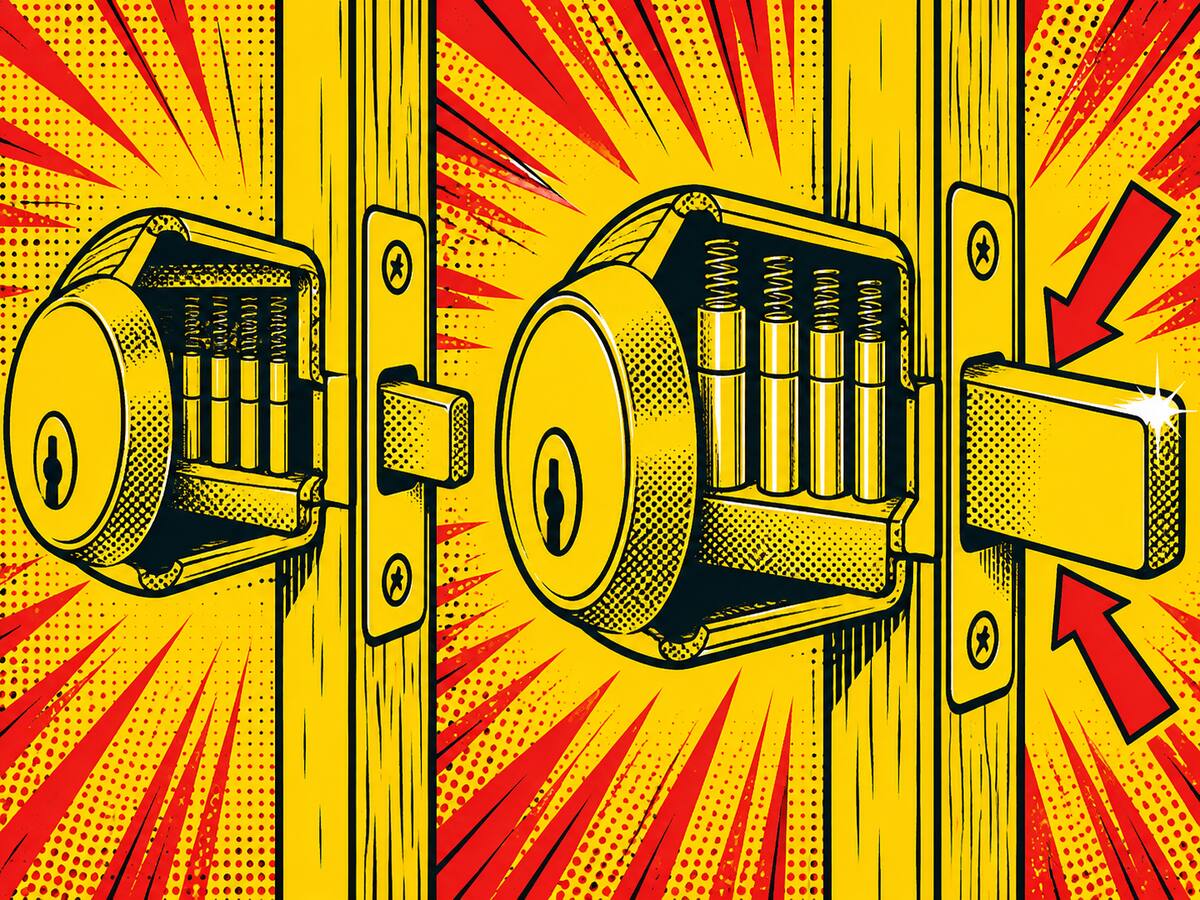
For a closer look at what a deadbolt does, see what a deadbolt lock is. Upgrading is optional. Rekeying is the part that answers the key question.
Rekey Now or Wait: A Decision by Hardware Condition
Rekey now when the locks are sound and you have no proof the keys were controlled. Replace now when a lock is loose, sticking or damaged, because rekeying will not fix a worn part. Leave a lock alone when it is low-risk, or when you already plan to replace it soon. The table below sorts each door by what you actually see.
| What you see | Do this | Why |
|---|---|---|
| Lock turns smoothly, no wobble, brand is readable on the lock | Rekey now | The hardware is fine and the only unknown is who holds old keys |
| Lock sticks, wobbles, the finish is already peeling, or the cylinder spins in the door | Replace now | A rekey does not repair worn or damaged parts |
| Builder confirms in writing that every lock was rekeyed at closing and you counted the keys | Leave alone for now | You have a record; revisit when you upgrade hardware |
| You plan to swap that lock soon anyway | Skip the rekey on that door | New hardware arrives with new keys |
| Interior privacy locks and closet latches | Leave alone | They are not your security line |
Not sure which column your doors are in? Send the count of exterior doors and a written description of each lock through request service, or call (844) 969-5625 and ask the dispatcher how to send photos. The dispatcher can sort the doors for you before anyone is sent out.
When the rekey is done, old keys stop working and the new ones are the only set that does. Ask the technician to test every new key in its lock before leaving, count the keys you are handed, and write that count next to your handoff notes. If you decided to key some doors alike, confirm which ones before you pay, so the front door and the garage entry do not end up on different keys by accident.
If you are weighing a smart lock, the moving checklist covers garage opener codes, outbuildings and smart-lock timing, and the rekey-or-replace guide walks through the five-question version of this decision for any move.
What It Costs (Rate Card: $30 per Lock, 3-Lock Minimum)
Residential rekeying with WOW Locks is $30 per lock with a 3-lock minimum. A new two-key set is $15. Parts and tax are additional. Many new homes have three or four exterior locks, so the minimum is usually met on the first call. Any add-on is quoted on the call before a technician is dispatched.
| Example | Exterior locks | Rate | Subtotal |
|---|---|---|---|
| Starter home | 3 | $30 each | $90 |
| Typical new build | 4 | $30 each | $120 |
| Larger plan | 6 | $30 each | $180 |
Treat these as arithmetic on the rate card, not a quote for your doors. A new deadbolt is $90 for the work, with hardware extra. Replacement and upgrade pricing for anything off the rate card is a custom quote after we see the door. The full list is on the flat-rate price list.
WOW Locks serves Buda and Kyle in Hays County and Leander in Williamson County, and has local technicians in Austin. For the service itself, see lock rekeying. WOW Locks holds Texas DPS (TOPS) license B10595301 and is insured and bonded.